Why Your Aqua-Therm Air Handler Is Blowing Cold Air (and What Property Managers Should Check First)
Jason Goldsberry
Oct 13 2026 13:00
Aqua-Therm heat depends on enough hot water reaching the coil. Likely causes include a stuck or failed circulator, air in the lines, water-heater or boiler trouble, or a controls issue. One cold unit usually points to components within that residence, while several cold units can indicate a building-water-supply problem.
For a maintenance supervisor, a no-heat call needs a quick diagnosis: Is the fan moving air? Is the water hot? Is that hot water circulating through the coil? In many DMV condo conversions and older mid-rises, answering those questions separates a straightforward in-unit repair from a larger building-system issue.
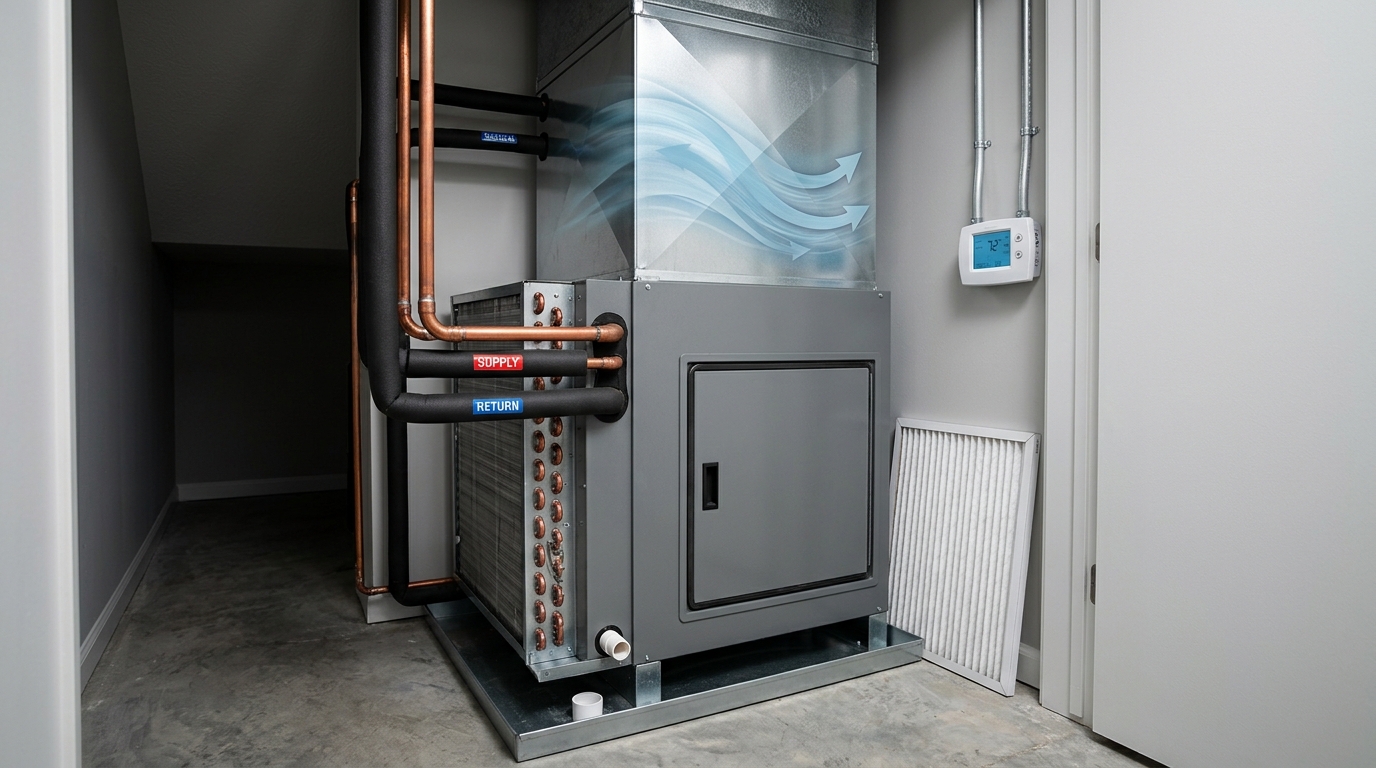
How Hydronic Air Handlers Make Heat
A hydronic air handler is essentially a small heating station inside the home. The heat source—typically a water heater or boiler—heats the building’s water. A circulator
moves that water through piping to the unit. Inside the air handler, the hot water travels through a coil, which resembles a compact radiator with closely spaced metal fins.
When the thermostat calls for heat, the fan
pulls room air across that hot coil and pushes warmed air through the ducts. If any link in that sequence fails, the resident may hear the equipment running but feel cold air at the registers.
Aqua-Therm systems are a core specialization for Advantage Service Group. Our technicians assess the complete heating path rather than assuming that a running fan means the unit is producing heat.
Common Reasons for Cold Air
Circulator Pump Seized After Summer
Circulators can sit unused through a long cooling season. When heating is first needed, a pump may be seized, weak, or electrically unresponsive. The fan can still operate normally, but without water movement, the coil never gets hot enough to heat the air.
This is a common reason a single residence reports no heat while nearby units are comfortable. A qualified technician can test the circulator, verify flow, and determine whether repair or replacement is appropriate.
Trapped Air in the Lines
Air trapped in hydronic piping blocks or reduces water flow. Residents may report gurgling sounds, uneven heat, a unit that starts warm and turns lukewarm, or persistent cold air even when the thermostat is set correctly. Air pockets are especially common after plumbing work, seasonal system changes, or a loss of water pressure.
Correcting the issue generally requires a technician to purge the system properly and confirm that water is circulating without air restrictions. Opening the unit or attempting to purge lines without the right equipment can cause leaks, scalding hazards, or additional air intrusion.
Water Heater or Boiler Not Hot Enough
The air handler cannot create heat that the building water supply does not provide. If the water heater or boiler is offline, underfiring, improperly controlled, or producing water below the needed temperature, the coil will not deliver adequate heat.
This becomes more likely when multiple units have weak or no heat. A maintenance team should note whether the domestic hot water system is operating, whether several residents are reporting similar symptoms, and whether the problem began at the same time across a stack or floor.
Control, Thermostat, or Wiring Issues
The thermostat tells the air handler when to heat, while relays, sensors, valves, and wiring carry out that request. A thermostat set incorrectly, a failed control, a loose connection, or a valve that does not open can interrupt the heating sequence. In these cases, the equipment may appear partially active but still fail to deliver heat.
Controls diagnosis involves live electrical components and system-specific testing. It should be handled by a qualified technician rather than treated as a resident-level repair.
Airflow Problems Such as Filters, Coils, or Blowers
Even with hot water at the coil, restricted airflow can make a unit feel ineffective. A clogged filter limits how much room air reaches the coil. A dirty coil reduces heat transfer. A weak blower may move too little air, while a failed blower may leave the coil hot but prevent warm air from reaching the living space.
Airflow issues can also create nuisance shutdowns or cause equipment to operate longer than necessary. They are often manageable when found early, which is one reason routine service matters in occupied multifamily buildings.
One Unit or Many
The number and location of complaints matter. If one condo is cold and surrounding units are heating normally, start with that unit’s circulator, air handler, thermostat, controls, filter, and local piping. This pattern is common in properties along Arlington’s Rosslyn, Ballston, Clarendon, and Pentagon City corridors, where individual units may have different maintenance histories even within the same building.
If several units are cold, particularly those on the same floor, stack, or side of the building, investigate the shared water source, system pressure, central controls, or distribution piping. The same diagnostic approach applies in Washington, DC communities around Dupont Circle, Columbia Heights, and Capitol Hill, as well as multifamily properties in Bethesda and Silver Spring.
Advantage Service Group is licensed in Virginia, Maryland, and Washington, DC, allowing one experienced team to support properties across the region while coordinating access with residents, concierge staff, building engineers, and property managers.
What to Check Before Calling
A few safe observations can help speed the service visit:
- Confirm that the thermostat is in heating mode and set above the current room temperature.
- Check whether the filter is visibly dirty or blocked, and replace it if it is an approved resident-accessible filter.
- Check the applicable breaker only if it is safe and accessible. If it has tripped repeatedly, leave it off and report it.
- Note whether the water heater is operating and whether there is normal hot water at fixtures, when applicable.
- Record whether the issue affects one unit, nearby units, an entire floor, or multiple areas of the property.
Do not open the air handler, remove panels, purge water lines, or perform electrical work. Those tasks require a qualified technician. Providing clear observations, access instructions, and the unit history helps ASG arrive prepared for the likely cause.
When Repair Stops Making Sense
Not every no-heat complaint calls for replacement. A failed circulator, clogged filter, control issue, or air pocket may be repairable. However, repeated circulator failures, chronic leaks, degraded coils, obsolete controls, recurring electrical problems, or repeated emergency calls can signal that the equipment is approaching the end of its useful service life.
For multifamily operators, replacement planning is easier when it is based on records instead of isolated emergencies. Keep unit-by-unit notes on service dates, failure types, parts replaced, water damage concerns, resident complaints, and access challenges. That history helps identify which units should be budgeted for proactive replacement and which can remain in service with routine maintenance.
For ongoing oversight, a preventative maintenance contract
can help identify circulator, airflow, controls, and coil concerns before a no-heat call becomes an after-hours escalation. Property teams can also learn more about Aqua-Therm air handler repair and maintenance, including diagnostic and repair support for these specialized systems.
For local building support, ASG provides HVAC service for Arlington's high-rise buildings
and multifamily HVAC service in Washington, DC, with occupied-building access coordination built into the service process.
A cold unit in winter is urgent, especially when a resident has no reliable heat. Property managers and condo owners can call Advantage Service Group at (703) 914-3601 day or night for 24/7 support.